What is local SEO, and why does a nearby competitor appear on Google Maps before your business? Local SEO is the work of making your business easier for Google to match with nearby searches, so you earn more calls, website visits, bookings, and direction requests.
It matters most when customers search with local intent, such as “electrician in Malmö” or “coffee near me.” This guide is for Swedish business owners who need practical ways to improve visibility without chasing rankings they cannot realistically win.
Key Takeaways
Google weighs relevance, distance, and prominence
Keep business details identical everywhere online
Reviews influence trust and local visibility
Track calls, leads, and direction requests
Win realistic service areas before wider regions
What Local SEO Means for Your Business
Local SEO improves your visibility in Google Search and Google Maps when people look for businesses near a specific place. It is different from broad SEO because Google uses the searcher’s location alongside your business information, website, reviews, and local reputation.
For a restaurant in Uppsala, local SEO targets searches such as “lunch Uppsala” and “restaurant near Uppsala Centralstation.” For a plumber serving Gothenburg, it targets searches for urgent help in the districts the business can reach quickly.
Local SEO is about qualified local demand, not vanity traffic from the other side of Sweden.
Google Business Profile drives Maps visibility
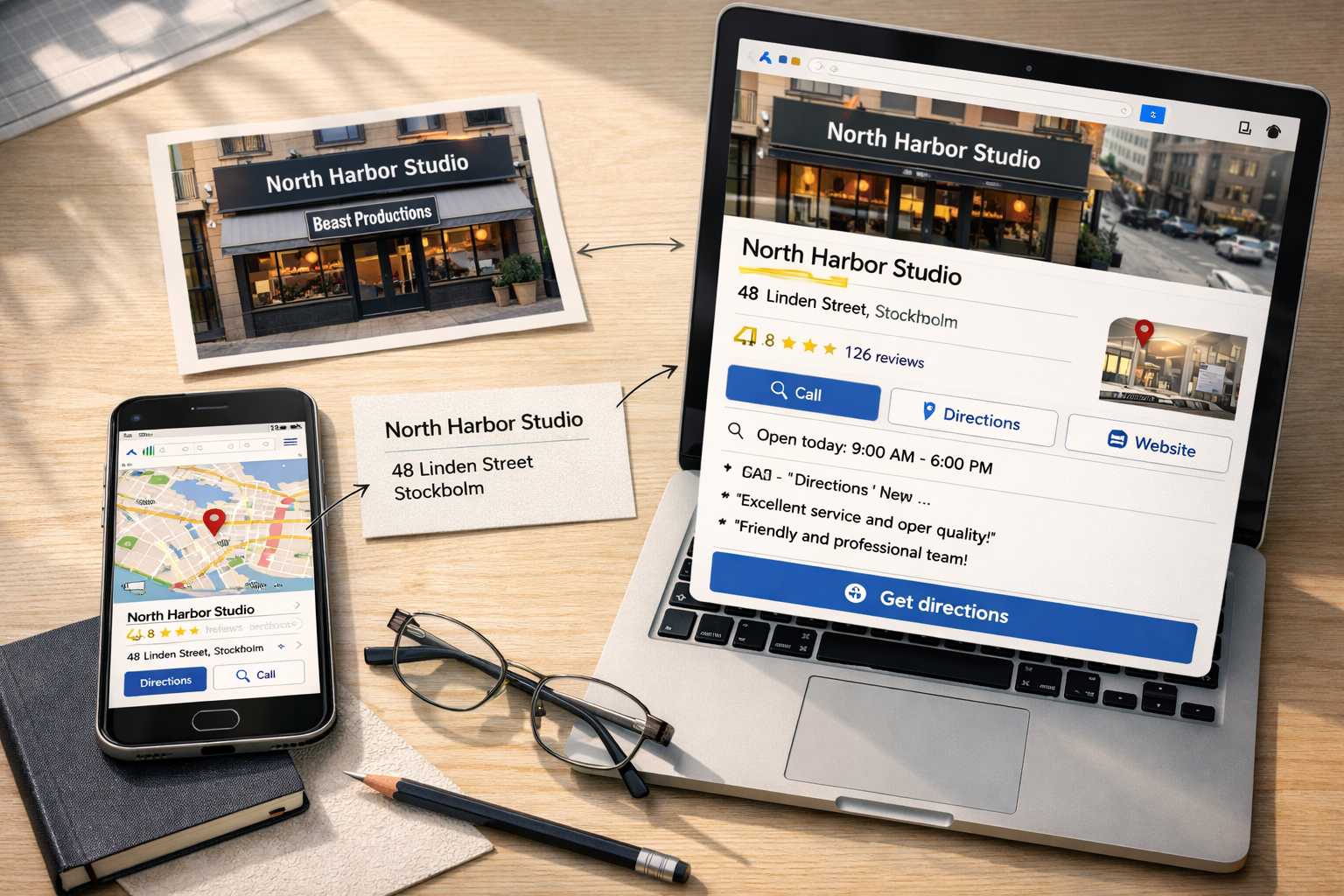
Your Google Business Profile is the free listing that appears in Google Maps and often in the local search results. It contains your name, category, address or service area, opening hours, phone number, photos, reviews, and updates.
A complete profile gives Google clearer signals. Choose the most accurate primary category, such as “Dentist” instead of a vague category, then add only relevant secondary categories. Incorrect categories bring the wrong searches and weaker leads.
Local Pack results capture high-intent searches
The Local Pack is the map section that often shows three businesses in Google Search. It can appear above standard organic results when Google detects local intent, particularly on mobile devices.
Getting into this area is valuable because people can call, request directions, or visit your website in a few taps. But position changes by location. A person searching from Södermalm can see different results from someone searching in Solna.
Local SEO also affects your website
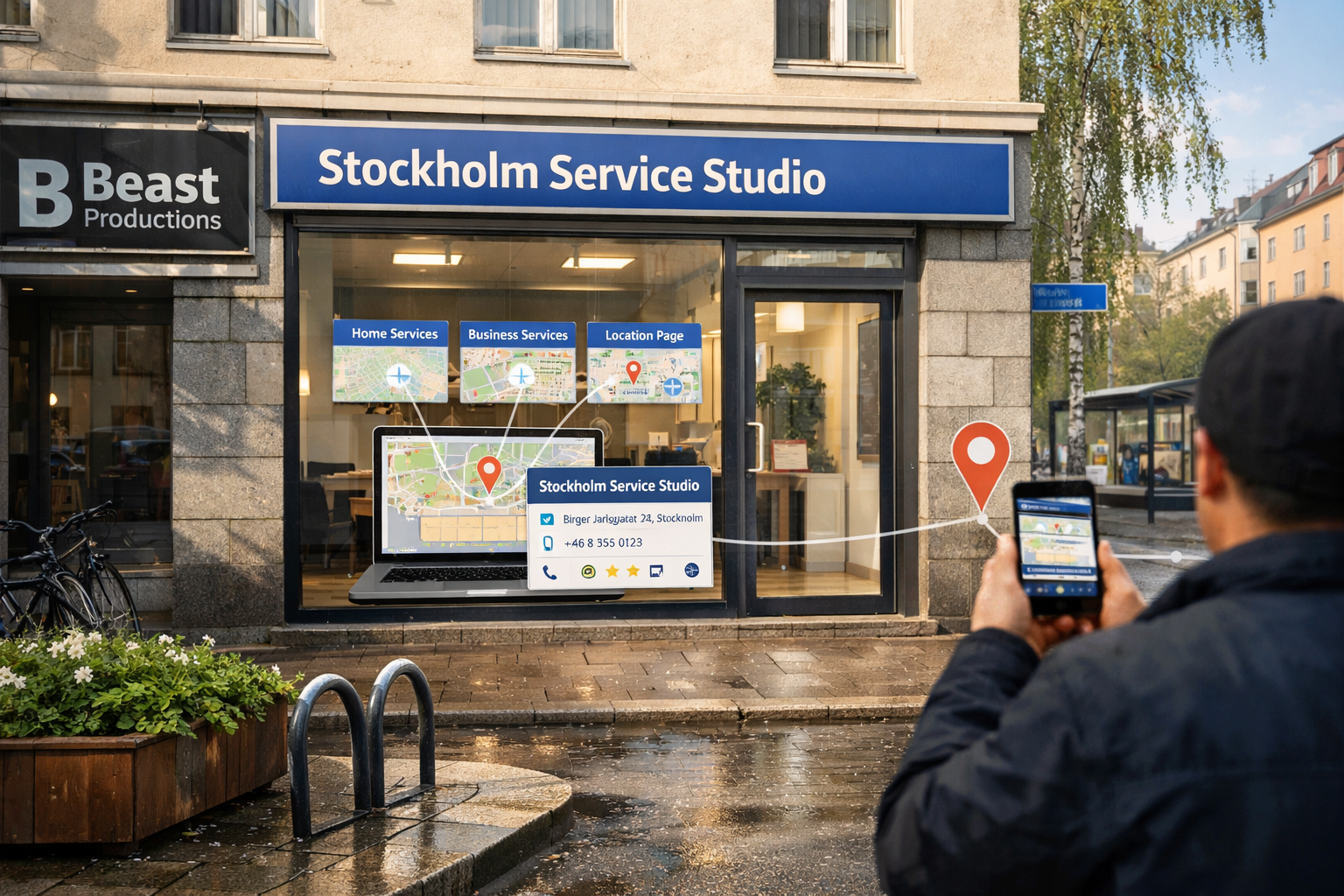
Google Maps is only one part of local SEO. Your website needs clear pages that explain where you operate, what you offer, and how customers contact you.
A Stockholm accounting firm, for example, should state its services, office location, contact details, and relevant local areas in plain language. Do not paste a list of 50 municipalities onto one page. It reads poorly and sends weak signals.
Local SEO works when your listing, website, and public reputation tell the same credible story.
Google Uses Relevance, Proximity, and Prominence
Google decides local visibility mainly through relevance, proximity, and prominence. You can improve relevance and prominence through steady work, but proximity is tied to where the searcher is located. That is why no agency can honestly promise top Maps positions across all of Stockholm.
Google does not publish a fixed score for these factors. Still, the practical meaning of each one is clear enough to guide your work.
Relevance: Match the search to the right service
Relevance means how well your Google Business Profile and website match what someone is searching for. A business category, service description, page title, and service page should all support the same offer.
If you install heat pumps, use precise terms people use, such as “heat pump installation,” “air-to-water heat pump,” and the local areas you serve. Add those terms naturally to service pages, not repeatedly to every sentence.
Accurate categories beat keyword-heavy descriptions. Adding “Best Locksmith Gothenburg” to a business name breaks Google’s guidelines and can trigger listing edits or suspension.
Proximity: Distance sets a real limit
Proximity is the distance between the searcher and your verified business location or the place named in their search. Someone who searches “hairdresser near me” in Lund will usually see businesses closer to them first.
Service-area businesses face the same reality. A mobile electrician may work across a wide area, but Google will not usually rank that business equally in every part of a large region. Focus on areas you can serve reliably.
Do not fight geography with wishful thinking.
Prominence: Build evidence that customers trust you
Prominence is your business’s visibility and reputation across the web. Google can use review quantity and quality, links from relevant websites, references in trusted directories, and well-known local coverage as signals.
A mention from a local business association, an event partnership page, or a supplier’s stockist page is often more useful than a random link from an unrelated website. Real-world recognition leaves useful digital evidence.
Build a Google Business Profile That Produces Leads
Treat your Google Business Profile as an active customer channel, not a one-time setup task. A profile that was created in 2022 and has not been checked since may show outdated hours, unanswered reviews, or missing services when a customer is ready to call.
Start with the basics. Your business name must match the name used on your signage, invoices, and website. Use a physical location only if customers can visit it during stated hours; otherwise, configure the profile as a service-area business.
Set the foundation before adding content
Complete every field Google gives you that genuinely applies. Add your main phone number, website URL, regular hours, holiday hours, service areas, and appointment link if you use one.
For Swedish holidays, update special hours before dates such as 2026-12-24 and 2026-12-31. Wrong opening hours cause missed visits and negative reviews, especially for cafés, clinics, and retail shops.
Use location-specific photos. A clear exterior image, entrance, team photo, and examples of completed work help customers recognize the business. Avoid stock photos where a real image can answer a practical question.
Choose services and categories with discipline
Select one primary category that describes the main revenue-generating service. Then use secondary categories only for services you actually provide. A bakery should not add “café” if it does not offer seating or drinks.
Write service descriptions that answer what is included, where the service is delivered, and how a customer starts. For example, a home cleaning company can describe recurring cleaning, end-of-tenancy cleaning, and the municipalities it serves.
Keep the profile active each month
Review your profile at least once a month. Check new reviews, customer questions, suggested edits, photos added by visitors, and performance data.
Use Google Business Profile posts for timely information, such as seasonal services or changed opening hours. A post is not a substitute for a strong website, but it confirms that the business is active.
A dependable monthly routine usually takes 30 to 60 minutes for one location.
Local Keywords and Location Pages Connect Searches to Services
Local keyword research tells you how customers describe their need and which geographic terms they add. You need these phrases on the pages where Google and customers expect to find them: service pages, contact pages, page titles, headings, and relevant body copy.
Use Google Search Console to see searches already producing impressions and clicks. Google Ads Keyword Planner can also provide ideas, while Google Maps autocomplete reveals wording people use around a town or district.
Start with service-plus-location searches
Combine your core service with realistic locations. Examples include “roof repair Västerås,” “accountant Örebro,” or “physiotherapy Hisingen.” Also look for service variations, urgent needs, prices, and booking terms.
Search the phrase yourself in an incognito window, but remember that results still vary by location. Look at what ranks: dedicated service pages, Google Business Profiles, directory pages, or national brands. This shows the intent you need to meet.
Create location pages only when they deserve to exist
A location page should help a customer in that area. It needs unique information, such as local availability, travel details, projects where public permission exists, nearby office access, or different services for that location.
Do not create near-identical pages for every suburb by changing only the town name. Google can treat these as thin doorway pages, and readers spot the shortcut immediately.
For a business with offices in Malmö and Helsingborg, separate location pages make sense because each office has its own address, hours, contact details, and local customer journey.
Improve on-page local SEO where it counts
Place your business name, address, and phone number in a consistent contact area on the website. Add a Google Map where visitors need directions, and make sure mobile users can tap the phone number.
Use structured data, specifically LocalBusiness schema, when it accurately reflects your business details. It does not guarantee Maps rankings, but it reduces ambiguity for search engines.
One strong service page per core offer is better than ten thin pages built around minor keyword variations.
Citations, Reviews, and Local Links Build Credibility
Google looks beyond your own website. Consistent business information across directories, authentic customer feedback, and relevant local links all support prominence and reduce customer doubt before the first contact.
This work is less exciting than publishing content, but it often exposes the problems blocking local growth: old phone numbers, duplicate listings, former addresses, and unanswered reviews.
Keep NAP details identical across the web
NAP means name, address, and phone number. Use the same format on your website, Google Business Profile, Facebook page, and relevant Swedish directories such as Hitta.se, Eniro, and allabolag.se.
If you move premises, update your website and Google Business Profile first, then major directories. Do not leave both the old and new address live indefinitely. That confuses customers and weakens trust signals.
A simple spreadsheet with listing URL, login access, and last-checked date prevents repeat errors.
Ask for reviews at the right moment
Ask after the service is completed and the customer has had the promised result. Send a direct Google review link in a follow-up email or text message, but never offer discounts or gifts in exchange for a positive review.
Respond to every review, including critical ones. Keep replies calm, avoid personal details, and move account-specific issues offline. A brief response within a few working days shows future customers that someone is paying attention.
Never buy reviews or use review-gating software. Both tactics create risk and damage credibility when customers discover the pattern.
Earn links through real local relationships
Local link building means getting relevant websites to link to your site because there is a genuine reason. Sponsoring a youth sports team, joining a local trade group, supplying a community event, or contributing expert input to a local publication can create legitimate opportunities.
Avoid packages that promise hundreds of links for a few thousand kr. Low-quality links are rarely connected to your market and create work later if they become a problem.
A 90-Day Local SEO Plan for a Swedish Small Business
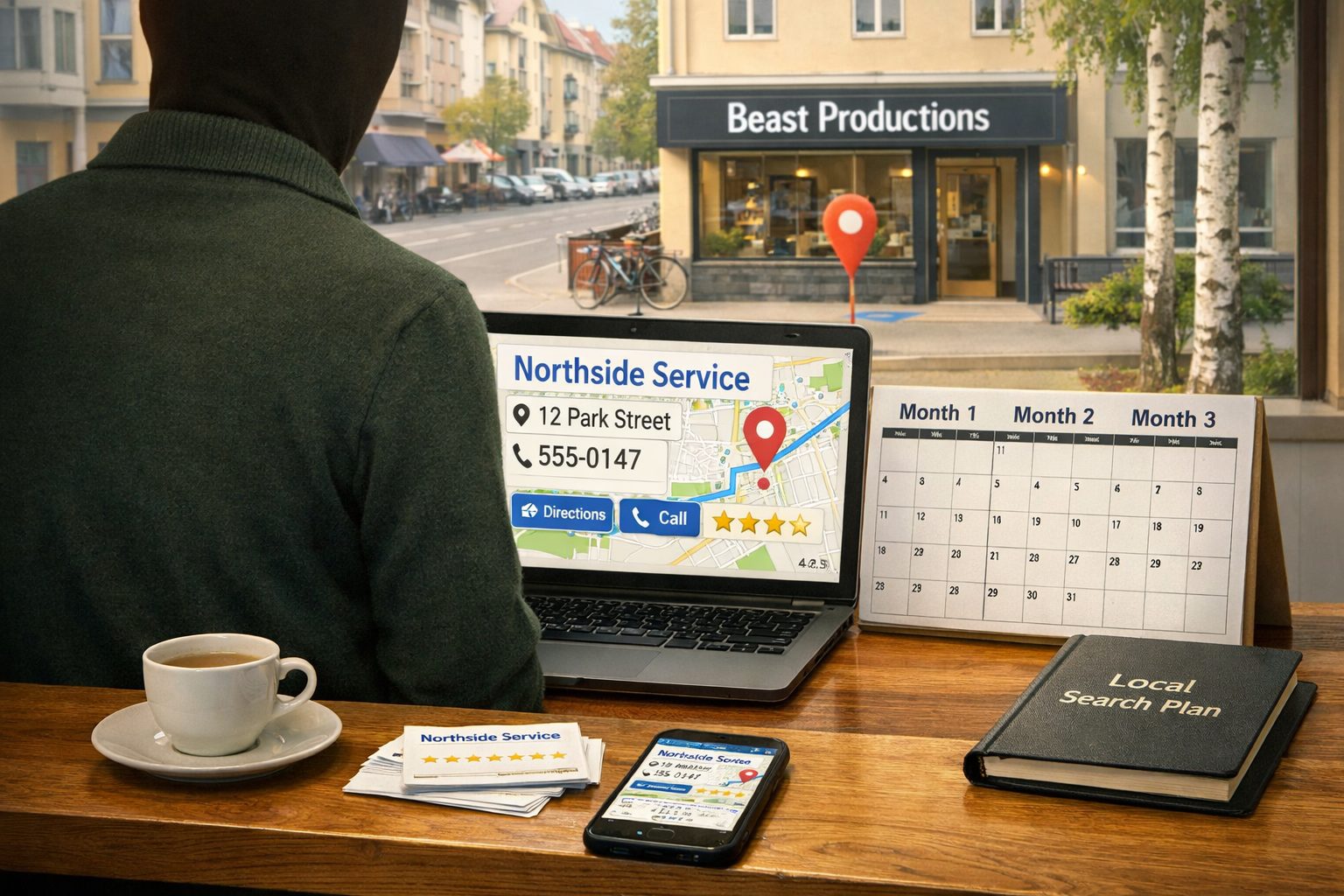
Local SEO improves through repeated maintenance, not one dramatic change. For a single-location business, a focused 90-day plan creates a clean foundation and enough data to judge what is working.
Expect roughly a weekend of owner time for the initial cleanup, then one hour per week. If you hire support, a realistic scope and deliverables matter more than a cheap monthly price.
Audit your Google Business Profile, website contact details, and top directory listings.
Correct NAP inconsistencies and remove or report duplicate Google listings.
Build or improve core service pages and one genuine location page.
Set up a review request process after completed jobs or purchases.
Add call, form, and booking tracking in Google Analytics 4.
Review Search Console, Maps actions, and lead quality every month.
Days 1 to 30: Fix trust and access problems
Claim and verify your Google Business Profile if you have not already. Confirm that you control the email address, phone number, and website accounts connected to it.
Check mobile contact paths. A customer should be able to call, request a quote, or book without searching through several pages. If the website is slow or confusing, more Maps visibility will not turn into more revenue.
Days 31 to 60: Publish pages that answer local intent
Improve the pages tied to your most profitable services first. Include clear pricing guidance when possible, response times you can honor, service areas, and a clear next step.
For some businesses, a separate page for emergency work makes sense. For others, it attracts leads outside opening hours that cannot be handled. Build pages around operational reality, not keywords alone.
Days 61 to 90: Measure local leads, not map screenshots
Track calls from the Google Business Profile, direction requests, website form submissions, bookings, and sales where your systems allow it. A rank tracker can monitor visibility from selected postcodes, but it cannot replace lead data.
If a keyword ranks well but produces irrelevant calls, adjust the page, category, or service wording. A lower position that brings profitable bookings is the better result.
Common Local SEO Mistakes That Waste Budget
The most expensive local SEO mistakes come from treating Google Maps as a static directory or assuming a single optimization session will hold a position. Local competitors change their profiles, collect reviews, update websites, and earn mentions over time.
Fixing these errors often produces faster progress than adding more blog posts.
Keyword stuffing creates risk, not relevance
Do not add city names, services, or promotional claims to your official business name unless they are part of the real-world name. Google’s business name rules exist to keep Maps results trustworthy.
The same applies to listing descriptions. Write for people deciding whether to contact you. Repeating “best electrician Stockholm” does not prove quality and makes the profile look unreliable.
Wide service areas do not create citywide rankings
A service-area business can list several areas, but that does not overcome proximity. A locksmith based far from central Gothenburg should not promise fast response across every district if travel time makes that impossible.
Choose a tight primary area first, build reviews and local relevance there, then expand service pages and partnerships where you can genuinely deliver.
Rankings alone hide the commercial result
A Maps position is useful diagnostic data, but it is not the goal. Track what happened after visibility: calls, quote requests, booked appointments, store visits, and closed sales.
Do not change five things at once. Make one meaningful improvement, record the date, and watch the result over several weeks. That makes it easier to identify what changed lead quality.
Conclusion
Start with your Google Business Profile, then fix NAP details across your website and major Swedish directories. Next, improve the service page that brings the most valuable enquiries and create a simple review request process. Measure calls, forms, and bookings monthly. If local SEO needs a technical audit or ongoing support, beastproductions.se can assess the gaps affecting local visibility.
Frequently Asked Questions
How long does local SEO take to work?
Local SEO usually needs several weeks before you see a reliable trend, while competitive areas can take months. Profile corrections can appear quickly, but reviews, links, website improvements, and lead tracking need sustained work.
Can I do local SEO without a physical shop?
Yes, service-area businesses can use local SEO without displaying a public address if customers do not visit the location. You still need a legitimate, verified business location and must hide the address in Google Business Profile when appropriate.
How much does local SEO cost in Sweden?
Costs vary by competition and number of locations, but a one-location business should first budget time for setup, content, review management, and reporting. Avoid providers selling guaranteed Maps positions for a fixed low fee, because proximity prevents honest citywide guarantees.
Does posting on Google Business Profile improve rankings?
Posts can keep your profile current and help customers see timely offers or updates, but they are not a direct shortcut to higher rankings. Prioritize correct details, relevant categories, customer reviews, and a website that answers local service searches.