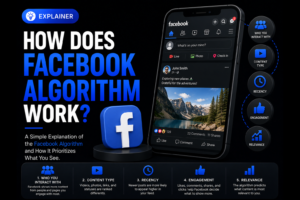

The Facebook algorithm is a collection of ranking systems that predict which posts, videos, and Stories each person is likely to find valuable. It considers activity, content information, and feedback. For a small business, the practical task is to create useful content for a clear audience and measure the response.
For Swedish small businesses, a useful starting point is a clear content marketing plan. Connect customer questions to practical posts, then review the results in Meta Business Suite.
Key Takeaways
Facebook uses different ranking systems across placements
Several predictions inform ranking; comments do not have a universal advantage over likes
Video viewing behavior is one part of personalized recommendations
Spam and unoriginal content can face distribution limits
Organic ranking and paid delivery work differently
Meta Business Suite reveals what earns attention
Facebook Ranks Content for Each Individual User
Facebook uses ranking systems across Feed, Reels, and Stories to personalize what people see. These systems combine predictions about likely interest and response; they do not assign every post one universal score that applies to every viewer. Paid ads use a separate delivery process.
That means two people in Gothenburg can see completely different posts from the same business page. One person may regularly watch your videos. Another may have ignored similar posts for months. Facebook responds to user behavior, not your posting schedule alone.
Feed Ranking Prioritizes Predicted Interest
Meta explains that ranking combines predictions based on activity and feedback, including surveys. The content someone has interacted with and the accounts they follow help inform those predictions.
For example, someone who often engages with a restaurant may be more interested in its lunch menu than a person who has never interacted with it. This is an illustration of personalization, not a guarantee of who will see a post.
Publish time-sensitive offers while people can still use them. Newness alone does not guarantee the top position: ranking also considers predicted interest, and older posts can remain relevant.
Use Stories to Build Familiarity
Stories have their own ranking system. From a business perspective, they offer space for brief updates and customer replies. Treat those replies as useful feedback rather than proof of a specific ranking boost.
A short Story asking viewers to choose between two products can invite a useful response. Keep each update focused and use interactive features available in your account.
Stories also expire after 24 hours, so they suit behind-the-scenes updates, last-minute availability, and short questions. Use a direct action such as replying, voting, or sending a message.
Relevance Is Personal, Not Universal
A post does not need to be viral to work. It needs to be relevant to the people most likely to become customers.
Audience response can inform personalization, but no single view, click, comment, or message guarantees wider distribution. Use those actions to understand what people find useful.
The Signals That Increase or Reduce Organic Reach
Facebook combines several predictions when ranking content. Its Feed ranking explanation shows why the balance can differ by viewer: some people tend to like posts, while others comment. There is no universal exchange rate between a like, comment, share, and minute watched.
Twenty comments and 100 likes describe different responses. Neither total alone tells you which post will reach more people or generate better enquiries. Judge attention alongside the business outcome.
Meaningful Interactions Show Real Interest
For your business, a useful interaction might be a product question, a customer sharing an experience, or a message asking about availability. These are practical signs of interest, not a published ranking formula.
Ask questions that help customers or improve your service. A local gym could ask members which class time they need next term; a B2B company could ask which reporting task takes the most time.
Avoid manufactured engagement, irrelevant captions, and excessive hashtags. Meta has described reach restrictions for spammy tactics. Invite a relevant conversation rather than asking for activity solely to increase a counter.
Watch Time Matters for Video and Reels
Viewing behavior helps Facebook personalize video recommendations, alongside other information. Watch time is useful to review, but it does not operate as a guaranteed reach target. A clear opening helps viewers decide whether the video answers their question.
Start with the customer problem, product result, or a clear visual change. Do not begin a 30-second Reel with a logo animation or a slow introduction. Put captions on screen because many people watch without sound.
A plumbing business, for instance, could open with a visible leak under a sink and then show the repair process. The practical demonstration is easier to understand than a talking-head video that begins with a company introduction.
Negative Feedback Helps Personalize Recommendations
Controls such as hiding content or selecting “Not Interested” help people shape their recommendations. Unfollowing also changes their connection to a Page. These actions should not be treated as one universal penalty applied to every future post.
A decline in response is a reason to review the content and audience fit. It does not establish that the Page has been penalized. Consider the pattern across several posts before changing your plan.
Before increasing frequency, test a clearer topic, stronger opening, or more useful offer. Posting more often creates extra work without guaranteeing extra attention.
Original Content Gives You a Stronger Position
Meta prioritizes original content in Feed and Reels. Re-uploading another creator’s work with only minor edits can be deprioritized. Using third-party material may qualify as original when it adds substantial new information, analysis, or creative value; superficial edits alone are insufficient.
Create material your business can contribute directly: staff expertise, product demonstrations, local updates, customer questions, or event footage. Original content can be simple. Test a useful phone video alongside more polished work and compare the response.
Reels, Feed, and Stories Need Different Creative Choices
Use Feed posts to add context, video to demonstrate, and Stories for timely updates. These uses overlap: Reels can also appear in Feed. Adapt the message to where and how people will encounter it.
Choose the format around the customer’s task. A detailed offer may suit an image and caption; a product demonstration may need video; a brief availability update can work in a Story.
Build Reels Around One Fast Idea
A Reel needs one clear promise. Show the outcome early, then make the middle easy to follow with movement, captions, and simple edits.
For a Swedish retailer, that could mean showing how a winter jacket fits in rainy 5°C weather rather than listing every feature on screen. The first frame should make sense even to someone who has never heard of the brand.
Use the length the explanation needs. Meta announced a unified video publishing flow in which new videos are shared as Reels, including longer videos. A two-minute explanation does not need to be split simply to fit an assumed short-Reel rule.
Use Feed for Context and Conversation
Feed supports posts with images, links, and video alongside captions. Use the caption to explain why the content matters and what the viewer can do next.
For a sequence of images, make each image useful on its own: show the problem, the choice, and the result. Preview the actual post layout before publishing because presentation varies by format.
Use directly relevant hashtags when they add context. They are not a substitute for a clear image, specific caption, and a topic your audience cares about.
Make Stories Interactive and Timely
For timely Stories, use a relevant question or reply prompt. Check which stickers and interactive tools are available in your Facebook account before planning content around them.
Consistency Helps Only When Each Post Has a Job
A consistent routine gives your audience opportunities to hear from you and helps your team improve its process. Frequency alone is not a ranking advantage.
As a manageable planning example, try two purposeful Feed posts or Reels per week, with Stories when you have something timely to share. This is a workload suggestion, not a Meta benchmark. Adjust to your resources and results.
Choose Content Pillars Before You Schedule
Set three or four content pillars based on customer needs. For example, a local business might use product proof, practical advice, local news, and team visibility.
Clear themes help your team choose relevant topics and avoid repetitive promotions. They are an editorial tool, not a requirement imposed by the ranking system.
Follow a Simple Weekly Publishing Process
Use a repeatable process that your team can sustain for at least eight weeks:
Review last week’s reach, watch time, comments, and link clicks.
Choose one customer question for a Reel or short video.
Create one Feed post that explains an offer or useful point.
Publish Stories on two or three active business days.
Reply to comments and messages while interest is fresh.
Record the strongest format and topic in your planning notes.
This takes planning, but it prevents last-minute posts that lack a clear purpose. A small business does not need a large content team. It needs a repeatable approval process and someone responsible for responding.
Posting Time Is a Test, Not a Rule
Post when your audience is likely to be available, but do not treat one “best time” as permanent. A local B2B company may see activity during weekday mornings, while a restaurant may get attention late afternoon.
Use Meta Business Suite to compare similar posts published at different times over several weeks. Keep the topic and format reasonably consistent during the test. Otherwise, you are measuring creative quality and timing at the same time.
Meta Business Suite Turns Reach Into Useful Decisions
Meta Business Suite is the place to assess what Facebook users do after your content appears. Review it weekly, not once every few months, because content decisions are easier to correct while the pattern is still visible.
Start with reach, then review the viewing and engagement metrics available for each format. Connect those observations with link clicks, enquiries, and other outcomes you can measure.
Compare Like With Like
Compare posts with similar formats, lengths, audiences, and goals. A 15-second Reel and a link post perform different jobs, so one number is unlikely to explain their value.
Do not delete a post quickly because the first hour looks quiet. Some posts gain attention later, especially when followers are not online at the same time.
Measure the Action That Fits the Goal
For awareness, review reach and video viewing behavior. For leads, record relevant messages, form submissions, booked calls, and website actions. Choose tracking that fits the campaign and check that it works before relying on its reports.
A post that receives fewer likes but generates five relevant messages is more valuable than a high-like post with no next step. Set the goal before publishing so the creative and call to action match.
For help connecting creative work, audience targeting, and reporting, explore Beast Productions’ social media marketing services.
Change One Variable at a Time
When a post underperforms, avoid changing everything at once. Test a new opening, different length, clearer caption, or another audience angle, then compare the result.
For example, keep the same offer but change a generic opening from “New service available” to a specific customer problem. If response improves, you have learned something useful. If you change the offer, image, caption, and posting time together, the result teaches you little.
Facebook Ads Use Delivery Systems, Not Organic Reach Rules
Paid delivery depends on campaign settings and an ad auction. Meta describes the auction as combining the advertiser’s bid, the estimated likelihood of the chosen action, and ad quality. Strong organic performance can suggest a message worth testing, but it does not guarantee paid results.
Pick the Objective Before Building the Ad
Define the business result before building the campaign, then choose the objective and performance goal that support it. If you need enquiries, measure relevant enquiries; if you need purchases, measure purchases. A click is only one step toward those outcomes.
Do not optimize for reactions simply because they are easy to count. Check that the chosen campaign setup supports the action you want customers to take.
For a local service business, keep the geographic settings aligned with the area you can serve. Avoid assuming that a more restricted audience will always improve cost or lead quality; compare the results.
Start With a Controlled Test Budget
Set a test budget you can afford and define a review point before launch. The right amount depends on the offer, audience, expected cost per result, and how much evidence you need. A short, low-volume test may leave substantial uncertainty.
Start with a small number of creative versions, such as a customer-problem video and a clear static image. Keep the offer consistent. Use an A/B test when you need a controlled comparison; ordinary delivery does not necessarily divide exposure evenly.
If the campaign has no tracking, unclear landing page, or no capacity to answer leads, fix that before spending more. Ad delivery cannot repair a weak offer or slow follow-up.
Boosting Is for Simple Visibility, Not Full Control
Boosting a post is quick and useful for a local announcement, event reminder, or content that already has strong organic response. It has fewer controls than a campaign created in Ads Manager.
Use Ads Manager when the campaign needs more detailed configuration, measurement, or structured testing. Review the controls available for your chosen campaign type before committing the budget.
Common Facebook Algorithm Mistakes That Waste Reach
A reach decline can have several explanations, including audience behavior, competition, content quality, or a distribution restriction. Review both the content results and any account or content-status notices before deciding what changed.
Chasing Likes Instead of Useful Response
Likes feel encouraging, but they do not prove that your content is building demand. A useful post should create a next action: a comment, message, saved idea, visit to your profile, or click to a relevant page.
Write captions that make the response obvious. Ask one relevant question, give one reason to click, or show one result. Multiple competing calls to action weaken the message.
Reusing Every Asset Without Adaptation
Adapt the opening, crop, caption, and call to action for each placement. Keep important details readable and preview the finished asset on a phone.
Ignoring Comments and Messages
Replying does not guarantee a ranking boost. It helps customers get answers, especially when a question concerns price, stock, or booking. That service benefit is enough reason to take responses seriously.
Set a response owner during business hours. If you cannot answer immediately, use a clear automated reply that states when someone will respond. Leaving questions unanswered turns active interest into lost momentum.
Treating Every Drop as an Algorithm Problem
Reach naturally fluctuates because audience behavior, competition, seasonality, creative quality, and content mix change. A lower-reach post is a signal to review, not proof that Facebook is suppressing your page.
Look at a group of posts over four weeks. Then decide whether the issue is the topic, creative, frequency, audience response, or the call to action.
Conclusion
Start with one audience, a few useful themes, and a sustainable publishing routine. After several weeks, review which posts attract relevant attention and enquiries. Improve one element at a time, and use a measured ad test when paid distribution supports a clear business goal.
Frequently Asked Questions
How long does Facebook take to distribute a new post?
There is no universal distribution timetable for every post. Review results over a period that suits its purpose rather than judging only the first few minutes. Time-sensitive announcements and evergreen advice may need different evaluation windows.
Do hashtags improve Facebook reach?
Relevant hashtags can add context, but they do not guarantee additional reach. Avoid excessive or unrelated hashtags and focus on whether the post answers a useful audience question.
Does responding to comments improve Facebook ranking?
Responding to comments supports conversation and customer trust, but it is not a guaranteed ranking switch. Reply when you have something useful to add, especially when a question could influence another potential customer.
Should a small business post every day on Facebook?
No. Choose a frequency that allows useful content and timely replies. Two weekly posts can be a manageable starting experiment, but the right routine depends on your capacity and audience response.