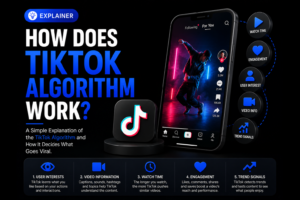

The TikTok algorithm uses recommendation systems to match eligible content with people likely to find it interesting. For You recommendations draw on user interactions, information about the content, and user information. These signals personalize each feed; they do not form a guaranteed formula for viral reach.
For Swedish business owners, reach is useful when it attracts relevant people and supports a clear next step. A focused content marketing plan connects useful videos with customer questions and business goals.
Key Takeaways
Recommendations reflect each viewer’s interests
Watch time is one of several recommendation signals
Use several metrics to understand audience response
Search keywords should match spoken video topics
Avoid judging a video from its first few views
Measure profile visits, leads, and sales
TikTok Recommends Videos Based on Viewer Signals
TikTok’s recommendation guidance describes personalized ranking of eligible content. Interactions such as watching, skipping, liking, sharing, and commenting help predict interest. Different features use signals differently, so a For You explanation should not be treated as a universal ranking rule.
For most users, interactions—including time spent watching—generally receive more weight in For You recommendations than other factors. The importance of signals can change over time. A clear topic helps you serve a particular audience without assuming any one action guarantees distribution.
The For You Feed Learns From Actions
Likes, viewing choices, comments, and shares provide different clues about interest. Do not assume that a save or share has a fixed value above a like. Review patterns across several relevant posts rather than treating one metric as proof of success.
Negative signals matter too. A fast swipe, choosing “Not interested,” hiding a creator, or repeatedly skipping similar clips tells TikTok to reduce comparable recommendations. You cannot force distribution with a hashtag if viewers leave after two seconds.
Video Details Help TikTok Categorize Content
Captions, on-screen text, spoken words, hashtags, sounds, and visual context all help TikTok understand what a video concerns. A video saying “How to choose a moving company in Gothenburg” gives clearer classification signals than “Big news today.”
Use plain language that your customer would type into TikTok Search. If you run a Malmö-based hair salon, say the service and location naturally in the video, add matching text on screen, and write a caption that confirms the subject.
Device language, country settings, and location can influence recommendations, especially for local relevance. They do not replace audience engagement. A Swedish-language video about a local service should still be understandable and engaging without relying on location alone.
Account Size Is Not the Main Reach Factor
Follower count helps you build a dependable starting audience, but it is not the main factor behind a video’s potential. TikTok assesses how people respond to the actual post, which is why accounts with few followers can gain significant reach.
Do not buy followers. Purchased accounts and low-quality followers distort your audience signals, lower meaningful engagement, and leave you with numbers that do not produce enquiries or sales.
Watch Time and Completion Help You Understand Interest
Watch time can help indicate interest, but it does not establish a fixed pass-or-fail test. Give people a reason to keep watching and compare retention across videos with similar topics and lengths.
A 12-second video needs a fast payoff. A 60-second tutorial needs a reason to stay, such as a clear problem, a sequence of steps, or an outcome shown early. Length alone does not win; retained attention does.
TikTok Analytics gives you practical signals to review. Look at average watch time, retention patterns where available, total views, traffic sources, and engagement. Compare videos of similar length and topic before deciding what worked.
Open With a Clear Reason to Watch
Start with the problem, result, or surprise. For a Swedish electrician, “This is why your fuse keeps tripping” is stronger than an opening logo animation. The viewer immediately knows why the video could matter.
Show the finished result early when the topic is visual. A renovation company can open with the completed kitchen, then explain the three choices that controlled the final cost. That structure gives the audience a reason to continue.
Avoid long greetings, repeated branding, and generic scene-setting. Your company name can appear in the profile, caption, or closing frame. The first moment belongs to the viewer’s question.
Give the Video One Job
One video should answer one question, demonstrate one product use, or make one focused point. Trying to explain pricing, company history, five services, and a special offer in 30 seconds creates confusion and reduces completion.
Use a simple sequence:
Name the viewer’s problem in the opening seconds.
Show the answer, process, or outcome.
Add one useful detail that proves relevance.
End with a clear next action.
Review retention before making the next version.
For example, a business selling accounting support could post a 35-second video about receipts from a work trip. It can name the common mistake, show the correct record-keeping action, and direct viewers to a longer guide or booking link.
Learn From Rewatches, Shares, and Saves
Rewatches often happen when a video includes a useful checklist, a fast visual process, or a detail viewers want to catch again. Saves are especially valuable for content people expect to use later, such as seasonal maintenance reminders or product comparisons.
Shares extend reach beyond the initial viewer. Content gets shared when it solves a problem people discuss with others: a restaurant recommendation, a moving checklist, a tax deadline reminder, or a local event tip.
Comments help when they start real conversation. Ask a specific question related to the topic, not a vague “What do you think?” A flooring business could ask whether viewers prefer light oak or dark oak in small rooms, then use answers to shape future videos.
TikTok SEO Connects Your Videos to Search Demand
TikTok also offers search. Match your video to the question a customer wants answered, rather than trying to make every upload appeal to everyone. Use clear, relevant language.
TikTok SEO starts before you write the caption. Decide the exact question, product category, or local service the video should address. Then make that phrase visible in your spoken script, on-screen text, and caption.
For a Swedish business, local specificity is an advantage. “Wedding photographer in Örebro” is more useful than “photography tips” if the goal is to book local clients. It tells both viewers and TikTok what the video is about.
Keywords Belong in Speech, Text, and Captions
Say the main phrase naturally near the beginning. Add it as readable text on screen, then include it in a concise caption. TikTok can interpret several types of content signals, so repeating a topic clearly is better than hiding it behind a clever but unclear slogan.
Use a caption that adds context instead of repeating every spoken word. A video on “how to prepare a home for sale in Lund” could include a short description of the three preparations covered and a relevant local service detail.
Keep on-screen text large enough to read on a phone. Test it on a smaller device before posting. Captions that are cut off by the interface or disappear after one second waste a strong search signal.
Hashtags Support Classification, Not Magic Reach
Use a small number of relevant hashtags. A practical approach is one specific topic hashtag, one category hashtag, and one location tag when location matters. Broad tags such as #fyp or #viral do not explain your subject to TikTok or your customer.
If your business creates content in both Swedish and English, separate the search intent. Make one video for a Swedish query and another for an English-speaking audience when the customer need differs. Mixing languages in one caption often weakens the message.
Search Content Has a Longer Useful Life
Trend-based videos can peak quickly. Search-led videos often receive views gradually as people continue looking for the answer. That makes them useful for services with longer buying cycles, such as web design, home improvement, or wedding planning.
Create a set of repeatable search topics around one service. A dental clinic might cover teeth whitening suitability, appointment preparation, aftercare, and common myths. The content becomes easier for TikTok to categorize and easier for viewers to trust.
Use TikTok’s search suggestions and Creator Search Insights, where available, to identify topics people search for. Treat these as starting points for useful videos, and confirm that each topic fits your customers.
Trends and Sounds Work Only When They Fit Your Brand
Trends can give a video a familiar format and an extra discovery route, but they do not guarantee results. Use a trend only when it makes your product, expertise, or customer problem clearer. Relevance is worth more than trend speed.
A popular sound can help TikTok associate a post with content viewers already enjoy, particularly when users are actively exploring that sound. But audio is a supporting signal, not a replacement for a useful story.
For posts promoting a brand, product, or service, review TikTok’s commercial music guidance. Its Commercial Music Library offers pre-cleared music for commercial use; other audio requires the necessary rights. A sound being available in the app does not by itself establish permission for a promotion.
Choose Trends With a Clear Business Angle
A local gym can adapt a trend to show common form mistakes. A law firm should not force the same trend into a serious consumer-rights topic if the tone undermines trust. The format must suit the audience’s expectations.
Set a quick decision rule: if you cannot explain the connection between the trend and your offer in one sentence, skip it. Spend that production time on a searchable customer question instead.
Originality Protects Long-Term Performance
TikTok rewards content that gives viewers a reason to stay. Reposted clips, copied scripts, videos with other platform watermarks, and generic stock footage without insight are weak foundations for a business account.
You do not need expensive production. A clean phone camera, good daylight, clear audio, and a direct script are enough for many 15- to 45-second videos. Poor sound is the common exception; viewers tolerate imperfect visuals more than speech they cannot understand.
Show real expertise. Demonstrate a process, answer a question you receive often, compare two options, or explain a decision a customer must make. That is more defensible than copying a viral template word for word.
Test Formats Without Changing Your Message
A single topic can become several formats: a face-to-camera explanation, a before-and-after sequence, a customer-question response, or a screen recording with voiceover. Test one format variable at a time.
For example, post two separate videos on the same service across different weeks. Keep the core question similar, but change the hook and structure. Then compare watch time, saves, profile visits, and comments instead of judging only total views.
Need help turning customer questions into videos? Beast Productions’ social media marketing services can support production and distribution while your team supplies the expertise behind the content.
Build a Testing System Instead of Chasing Viral Views
A useful TikTok strategy is a repeatable testing system. Publish focused videos, leave enough time for distribution, review the right metrics, and create a better version of what earns qualified attention. Views are a starting metric, not the final result.
For a small business, plan a realistic publishing rhythm you can sustain for at least six weeks. Two well-made videos per week are better than seven rushed videos followed by a month of silence.
Set up your profile before increasing output. Use a recognizable profile image, a description that states what you offer, and one clear destination link where available. If a viewer cannot understand your business in five seconds, strong reach will leak away.
Use Analytics to Find Patterns
TikTok Analytics can show views, watch time, audience activity, traffic sources, engagement, profile views, and follower changes. Check results after posting, then revisit after several days because distribution does not always finish immediately.
Track the topic, hook, length, call to action, views, watch time, saves, shares, profile visits, and enquiries. Use the same review method across similar videos so the results guide your next decision.
A 5,000-view video that sends 40 relevant profile visits can be more valuable than a 50,000-view comedy clip that attracts no potential customers. Connect TikTok activity to website analytics, booking requests, discount-code use, or direct messages.
Do Not Delete a Video Too Soon
Do not judge an upload from its first few views. TikTok’s creator guidance recommends reviewing the broader performance picture and allowing time for results to develop. This is not a promise of a particular testing schedule.
Leave posts live unless they contain an error, outdated offer, legal issue, or brand-risk problem. If the hook failed, create an improved version later rather than deleting the original and losing the learning.
Do not repost the same file repeatedly. Rebuild the video with a new opening, clearer framing, or stronger edit. That gives viewers a better reason to engage and prevents your feed from looking repetitive.
Set Conversion Goals Before You Post
Choose the job of each video: create awareness, earn search traffic, build trust, drive profile visits, generate messages, or move viewers to a booking page. The goal determines your call to action.
A low-cost product might use a direct shop link. A higher-consideration service often needs a softer next step, such as a consultation page, a downloadable checklist, or a profile visit. Asking for a sale before trust exists usually suppresses response.
For paid promotion, start with an organic post that already earned saves, shares, or profile visits. Promote evidence, not hope. Set a fixed test budget in SEK and track the action that matters, such as leads, rather than treating impressions as success.
Common TikTok Algorithm Mistakes That Limit Business Results
When results disappoint, review topic fit, the opening, and the next step before drawing conclusions about distribution. Check any account or post eligibility notices too. Consistency means useful, relevant content.
The first mistake is treating follower count as the main target. Followers matter when they are potential buyers, but TikTok distributes videos beyond followers. Build a clear content category so the right people recognize why they should return.
Avoid Trend Chasing That Damages Trust
A trend can attract attention from the wrong audience. If a business that sells professional services posts only jokes and dances, viewers may remember the entertainment but not the offer or expertise.
Choose trend participation when it supports a product demonstration, a timely seasonal need, or a familiar customer problem. Skip it when the format conflicts with your voice, legal obligations, or the decision your customer needs help making.
Some industries need extra care. Financial, medical, legal, and regulated claims should be reviewed before publishing. A fast trend is never worth misleading information or a compliance issue.
Fix Weak Videos With Better Inputs
When a video underperforms, diagnose the first failure point. Low watch time often points to a weak opening, unclear topic, slow pacing, or a mismatch between the hook and the actual content.
Low profile visits can mean the video was helpful but did not establish your expertise or next step. Low saves and shares can mean the content was entertaining but not useful enough to keep. These are different problems and need different fixes.
Do not blame the algorithm before reviewing the video. Look at the first frame, first spoken line, text readability, sound quality, and whether the promised answer arrives quickly. Small changes at the start often matter more than a complete content overhaul.
Protect Your Account and Your Data
Use two-step verification and limit account access to people who need it. A compromised TikTok account can damage customer trust and disrupt active campaigns.
Keep a record of who owns the account, the linked email address, and the connected business assets. If an agency or freelancer helps with content, give access through appropriate account roles where possible rather than sharing a personal password.
Before filming identifiable people, agree how the footage will be used and review the permissions and data-protection requirements that apply. Take particular care when reusing footage in paid campaigns.
Conclusion
Start with one customer question your business answers every week. Create two focused TikTok videos around it, use the same search phrase in speech and text, and keep both live for several days. Then compare watch time, saves, profile visits, and enquiries. Repeat the topic that brings qualified attention, not the one that merely collects views.
Frequently Asked Questions
How long does TikTok take to push a video?
There is no guaranteed timetable for gaining reach. Give a useful, accurate post time to find viewers and review its performance over time. Remove or correct mistakes promptly, but avoid treating the first hour as a final verdict.
Should a business post on TikTok every day?
No. Post at a pace you can maintain with relevant, well-edited content; two focused videos per week is a practical starting point for many small businesses. Increase frequency only when your quality and measurement process remain consistent.
Do hashtags still matter on TikTok?
Yes. Relevant hashtags help describe the subject, but adding more does not guarantee wider reach. Use a clear caption and a few accurate topic tags; broad tags such as #fyp are not a shortcut to a relevant audience.
Why do some TikTok videos get views but no customers?
High views can come from an audience that has no buying intent or from content with no clear next step. Match the video topic to your service, explain who it is for, and make your profile and link useful before pursuing more reach.